How to Plan Custom Educational Products and Learning Kits: Books, Printed Components and Packaging
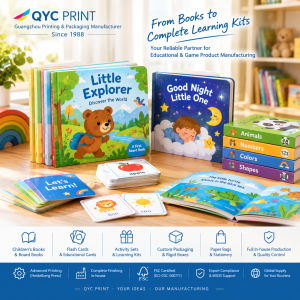
Educational products are often more than a single book or set of flashcards. A complete learning product may include children’s books, workbooks, activity sheets, stickers, printed cards, instruction materials and custom packaging.
For publishers, educational brands, toy companies and product developers, planning these components together can help create a more consistent product and simplify manufacturing coordination.
QYC Print supports custom printing and paper product manufacturing, from individual printed items to coordinated multi-component projects. This guide explains how to plan a custom educational product or learning kit, including product structure, materials, binding options, packaging and sample approval.
1. Define the Educational Product Before Manufacturing
Start by identifying the product’s purpose, target age group and intended use.
A learning product designed for independent reading may require a different book format from a workbook used at a desk. A learning kit intended for retail may also need different packaging from materials supplied directly to schools.
Before requesting a quotation, clarify:
- The target age group and learning purpose
- The number and type of products in the project
- The approximate page count and finished dimensions
- The intended paper, board and cover materials
- The required printing, binding and finishing methods
- The packaging format and quantity per set
- The estimated order quantity and delivery schedule
These details help manufacturers assess the complete project instead of quoting each component without understanding how the parts fit together.
2. Choose the Right Books and Printed Components
A custom educational product may contain several different printed items.
Children’s Books and Publications
Custom children’s books may include picture books, educational readers, storybooks, board books, activity books, workbooks and educational guides.
The most suitable format depends on the content, page count, expected handling, visual design and budget. For younger audiences, the thickness of the pages, the strength of the binding and the overall construction deserve particular attention.
Workbooks and Activity Books
Workbooks may contain exercises, writing spaces, illustrations, puzzles, tracing activities or instructions. The paper should suit the intended activity. For example, writing and coloring may require different paper characteristics from a book used mainly for reading.
Page layout should also account for margins, binding clearance and how the book will be opened during use.
Flashcards and Learning Cards
Flashcards can support vocabulary learning, matching games, memory activities and early learning exercises.
Important specifications include card size, paperboard thickness, surface finish, corner treatment, printing requirements and the number of cards in each set. If the cards will be packaged with a book or workbook, the complete set should be planned together.
Stickers, Worksheets and Other Components
Stickers, activity sheets, labels, folded instructions and paper inserts can extend the functionality of an educational product.
When multiple components are included, prepare a component list that identifies each item, its dimensions, material, quantity per set and any special finishing requirements.
3. Select a Binding Method That Fits the Book
Different book structures require different binding approaches. Page count, paper characteristics, opening behavior, durability requirements and budget should all be considered.
Saddle Stitching
Saddle stitching is commonly used for thinner booklets, activity books, workbooks and brochures. It can be suitable when the page count and paper specifications are compatible with the binding method.
Perfect Binding
Perfect binding is often used for paperback books, catalogs, workbooks and educational publications. The final result depends on factors such as the book’s thickness, paper selection and adhesive system.
PUR Binding
PUR binding uses polyurethane reactive adhesive. It may be considered for certain books and publications where the adhesive performance and finished construction suit the project requirements. The appropriate choice should be confirmed against the paper, book thickness and intended use.
Case Binding
Case binding is commonly used for hardcover books, premium children’s books, gift books and other publications requiring a rigid cover structure.
Board Book Construction
Board books use thick paperboard pages and require a construction method designed for the intended format. Page attachment, board thickness, cover construction and edge finishing should be evaluated together.
Spiral and Wire-O Binding
Spiral and Wire-O binding are useful for selected workbooks, planners, activity materials and educational products that benefit from opening flat.
Sewn Binding
Sewn binding methods may be suitable for publications requiring particular book-block construction or durability characteristics. The exact method should be selected according to the design and manufacturing requirements.
No single binding method is ideal for every book. The best option is the one that meets the product’s functional needs while remaining practical for production and budget.
4. Plan Custom Packaging for the Complete Kit
Packaging should be designed around the actual contents of the learning kit.
Depending on the project, packaging may include folding cartons, rigid boxes, paperboard sleeves, internal dividers, inserts or other custom paper packaging.
Before finalizing the box design, confirm:
- The number and dimensions of the components
- The arrangement of books, cards, stickers and accessories
- The required protection during storage and transport
- The opening and closing method
- The printed artwork and finishing requirements
- The packing sequence and quantity per shipping carton
A packaging structure should be tested with the actual components. A box that looks correct on screen may require adjustments after the printed items and inserts are assembled.
5. Prepare a Manufacturing Specification
A clear specification reduces misunderstandings during quotation, sampling and production.
For each component, provide the available information about size, page count, materials, printing, finishing and quantity. If the product is a kit, include a bill of materials or component list showing what goes into one finished set.
Artwork files should be checked for dimensions, bleed, image resolution, color requirements and any special production instructions. Structural designs, dielines and binding details should be confirmed before mass production.
If some specifications are not yet finalized, identify them as open decisions instead of treating estimates as approved requirements.
6. Review Samples Before Mass Production
Sampling helps confirm whether the proposed construction works in practice.
Depending on the project, sample review may include:
- Finished dimensions and page count
- Paper and board selection
- Print quality and color consistency
- Binding strength and opening behavior
- Cutting, folding and finishing
- Packaging fit and component arrangement
- Assembly sequence and final presentation
For a multi-component learning kit, reviewing only one printed item may not be sufficient. The complete set should be assembled and checked so that compatibility between the components and packaging can be evaluated.
Approval should be based on the agreed specifications and sample requirements.
7. Coordinate the Project as One Manufacturing System
A custom educational product may involve several products and manufacturing steps. Treating each item as an isolated order can make coordination more difficult.
A project-based approach considers the books, cards, stickers, instructions and packaging together. It also considers production sequence, quality checkpoints, assembly requirements and final packing.
For repeat orders or future editions, retain approved specifications and artwork versions. When content, quantity, dimensions or materials change, review whether those changes affect the other components or packaging.
This approach can help publishers and product developers manage revisions more clearly and prepare for future product releases.
8. What to Include in a Request for Quotation
To help a manufacturer evaluate a custom educational product, provide as much of the following information as is available:
- Product description and intended use
- Component list and quantity per set
- Finished dimensions and page counts
- Paper, board and cover requirements
- Printing and color specifications
- Binding and finishing preferences
- Packaging design or reference images
- Order quantity and expected repeat-order plans
- Delivery destination and target schedule
- Artwork, dielines or sample references
If some details remain undecided, explain the current requirements and ask the manufacturer to identify the information needed to complete the specification.
Frequently Asked Questions
Can educational books and learning kits be customized?
Yes. Depending on manufacturing requirements, books, workbooks, cards, stickers, printed inserts and packaging can be specified and produced for a particular project. The final scope depends on the approved design, materials, quantities and production capabilities.
Can books, flashcards and packaging be produced as one project?
They can be planned as a coordinated multi-component project. The component list, production specifications, sample requirements and packing arrangement should be agreed upon in advance.
Which binding method is best for children’s books?
There is no universal best method. Saddle stitching may suit thinner booklets, perfect binding may suit some paperback publications, case binding is common for hardcover books, and board book construction is used for thick-page formats. The appropriate option depends on the book design, page count, intended use and budget.
What information is needed for a custom educational product quotation?
The most useful starting information includes product dimensions, page counts, materials, printing requirements, binding preferences, quantities, packaging details and delivery expectations. Artwork or reference samples can help clarify the requirements.
Can a learning kit be updated for future editions?
Yes, if the project specifications and component files are maintained. Before producing a new edition, review changes to the content, dimensions, quantities, materials and packaging to determine whether other components need to be revised.
Plan Your Custom Educational Product with QYC Print
Whether you are developing children’s books, workbooks, flashcards, activity materials or a complete educational learning kit, careful planning helps align the printed components, binding methods and packaging.
QYC Print works with customers on custom paper-based products and coordinated printing and packaging projects. Share your product concept, component list, specifications or reference materials to begin discussing a manufacturing solution tailored to your project.
Your Ideas. Our Manufacturing.
Planning a Custom Educational Product?
Share your product concept, specifications or component list with QYC Print. Our team can discuss your custom printing, bookbinding and packaging requirements.
Contact QYC Print to Discuss Your Project