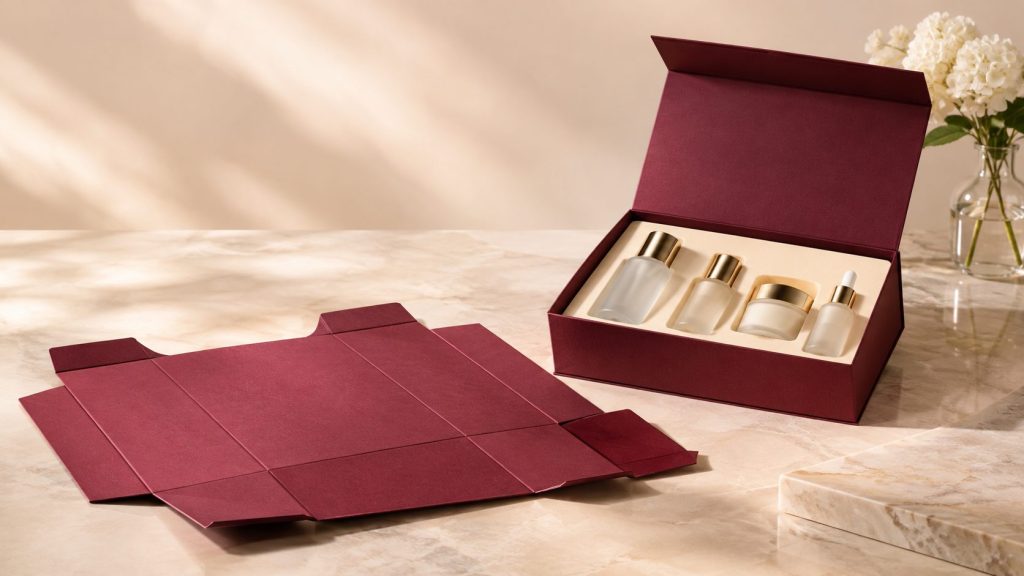
Collapsible rigid boxes for beauty brands combine premium presentation with a packaging structure designed to fold or flatten before assembly. For skincare and cosmetic gift sets, this approach may help brands manage empty-box storage while maintaining a high-end unboxing experience.
However, choosing the right packaging requires more than comparing appearance. Buyers also need to consider product fit, structural strength, inserts, printing finishes, assembly labor, freight, and total project cost.
This practical OEM packaging guide explains how to evaluate collapsible rigid boxes, prepare a component bill of materials, approve samples, and submit a clear request for quotation.
What Are Collapsible Rigid Boxes for Beauty Brands?
A collapsible rigid box is a presentation-style packaging structure designed to fold or flatten when not assembled. Depending on the design, it may include reinforced paperboard panels, printed wrapping paper, folding connections, and a closure system.
Unlike conventional preassembled rigid boxes, collapsible structures may occupy less space during empty-box storage and transportation.
For premium skincare collections, custom collapsible rigid boxes are worth evaluating when brands want both a refined presentation and a practical flat-pack format.
Important: Different collapsible structures have different folding mechanisms. Load capacity, closure performance, assembly requirements, and suitability for heavy cosmetic products must be confirmed through physical sampling.
Collapsible Rigid Boxes vs. Traditional Rigid Boxes vs. Folding Cartons
Beauty brands commonly compare three paper-based packaging structures before choosing the right format for a cosmetic collection.
Collapsible Rigid Boxes
Best for: Premium cosmetic gift sets that need a rigid-style presentation and may benefit from flat-pack storage.
These boxes fold or flatten before assembly. Buyers should review the folding mechanism, panel alignment, structural strength, closure system, and assembly time.
Traditional Rigid Boxes
Best for: High-end packaging programs that prioritize a firm, preassembled presentation.
Traditional rigid boxes generally arrive assembled. This may simplify filling operations, but their empty-box transportation and storage volume should be included in cost calculations.
Folding Cartons
Best for: Lightweight cosmetic products and retail packaging where conventional folding paperboard is suitable.
Folding cartons are commonly supplied flat. Buyers should compare paperboard stiffness, product weight, printing requirements, and final presentation.
Which Structure Should Your Brand Choose?
- Lightweight retail cosmetics: Consider a folding carton.
- Premium multi-product gift sets: Evaluate a rigid-style box.
- Limited empty-box storage space: Compare collapsible rigid structures.
- Complex product arrangements: Prioritize insert design and product fit.
Explore QYC Print’s custom packaging projects for related paper packaging applications.
When Should Beauty Brands Consider Collapsible Rigid Boxes?
Premium Skincare Gift Sets
Skincare gift sets may contain creams, serums, lotions, jars, and accessories. A coordinated insert can organize these products inside one presentation box.
Seasonal Cosmetic Collections
Holiday packaging, limited-edition beauty collections, and promotional sets often require distinctive printing, brand colors, and decorative finishing.
Packaging Shipped to Separate Filling Locations
Some brands send empty boxes to a separate filling or fulfillment partner. For these projects, flat-pack dimensions, assembly instructions, closure reliability, and packing consistency deserve particular attention.
Materials and Components: Build a Clear Packaging BOM
A detailed bill of materials, or BOM, helps buyers understand how the packaging is manufactured and which components may require separate sourcing.
1. Structural Paperboard
Structural paperboard forms the main panels and contributes to box rigidity. Specifications should include board grade, thickness, stiffness, dimensions, and suitability for the folding construction.
2. Printed Wrapping Paper
Wrapping paper creates the branded exterior. Buyers should confirm paper type, printing method, color requirements, surface texture, and finishing.
3. Folding and Connecting Elements
These components enable the structure to fold and assemble. Their attachment method and intended assembly frequency should be evaluated during development.
4. Closure Components
The closure helps keep the assembled box in its intended position. The appropriate solution depends on structural design, product weight, and presentation requirements.
5. Custom Cosmetic Inserts
Inserts organize skincare bottles, jars, tubes, and accessories. Their material, dimensions, cutouts, and product fit should be checked using representative products.
6. Individual and Export Packaging
Export packaging may include individual protection, master cartons, labels, and assembly instructions. Buyers should confirm carton dimensions, packing quantities, and delivery requirements.
Why a Component BOM Matters
A clear BOM helps separate paper-based manufacturing from specialized sourced components. It also supports accurate quotations, sampling plans, and quality-control requirements.
For a coordinated packaging program, buyers can review outer boxes, inserts, printed accessories, and related custom packaging solutions together.
How to Choose Inserts for Cosmetic Bottles and Skincare Products
The insert is one of the most important functional components in a beauty gift box. It affects product positioning, presentation, handling, and the unboxing experience.
Possible solutions include folded paperboard inserts, printed partitions, and other custom-fit structures. Additional sourced materials may be considered when products need different support or protection characteristics.
Information Needed for Insert Design
- Exact dimensions of every bottle, jar, tube, or accessory
- Individual product weights and total set weight
- Cap, pump, and dispenser dimensions
- Preferred product arrangement and orientation
- Fragility and handling requirements
- Desired spacing and visual presentation
Buyer tip: Provide actual product samples whenever possible. Drawings may not capture every rounded shoulder, protruding cap, or dimensional tolerance.
For glass cosmetic bottles, physical fit and handling evaluation are especially important. An attractive insert does not automatically guarantee sufficient product protection.
Printing and Finishing Options for Premium Cosmetic Packaging
Printing and finishing help beauty brands create a consistent identity across outer boxes, inserts, sleeves, cards, and other paper-based packaging components.
Offset Printing
Offset printing can be considered for detailed artwork, coordinated packaging graphics, and suitable production quantities.
Foil Stamping
Foil stamping can emphasize logos and selected decorative details. Placement should be reviewed around folds, corners, and wrapped edges.
Embossing and Debossing
Raised or recessed details can create tactile effects on suitable materials. Paper selection and structural compatibility should be reviewed during sampling.
Spot UV and Lamination
Selected gloss effects and surface finishes may enhance printed wrapping paper. Their compatibility with folding joints and wrapping processes should be evaluated.
Production consideration: A finish that performs well on a flat printed sheet may behave differently around a folding joint or wrapped corner. A finished structural sample is more informative than a flat print proof alone.
Do Collapsible Rigid Boxes Reduce Shipping Costs?
Collapsible rigid boxes may reduce empty-box shipping volume, but lower total costs are not guaranteed.
A flat-pack structure may occupy less warehouse space than a preassembled rigid box. However, total cost depends on construction complexity, packing dimensions, gross weight, freight method, assembly labor, and handling requirements.
Compare the Complete Packaging Cost
- Manufacturing cost per box
- Additional structural and closure components
- Empty-box packing dimensions
- Export-carton quantities and gross weight
- Freight method and chargeable weight
- Warehouse storage requirements
- Assembly labor at the filling location
- Handling and quality-control requirements
For example, a collapsible design may reduce empty-box volume but require additional assembly work. A conventional rigid box may occupy more space but arrive ready for filling.
The right comparison is based on total landed and operational cost, not an assumed percentage of freight savings.
How to Prepare an Accurate OEM Packaging RFQ
A clear request for quotation helps reduce assumptions, repeated revisions, and delays during packaging development.
Beauty Packaging RFQ Checklist
- Packaging application: Skincare gift set, cosmetic collection, promotional kit, or another use.
- Box structure: Preferred collapsible design, drawing, or reference images.
- Dimensions: Finished external and internal measurements.
- Product contents: Item quantities, dimensions, weights, and arrangement.
- Materials: Preferred structural board, wrapping paper, and insert materials.
- Artwork: Logo files, brand colors, and printing requirements.
- Finishing: Lamination, foil stamping, embossing, or other requested processes.
- Quantity: Initial order quantity and potential repeat quantities.
- Sampling: Structural prototype or printed approval sample.
- Packing: Individual protection, export cartons, and assembly instructions.
- Delivery: Destination, target date, and preferred trade terms.
If the structure is still at the concept stage, provide the information already available and identify which specifications need further development.
What Should Buyers Check Before Mass Production?
Sampling is particularly important for collapsible packaging because both appearance and assembly performance affect the finished product.
Structural Sample Approval
- Finished dimensions and panel alignment
- Folding and assembly sequence
- Closure function and box stability
- Insert fit with representative products
Printed Sample Approval
- Brand colors and artwork placement
- Wrapping quality and corner appearance
- Surface finishing and decorative effects
- Visible marks around folding areas
Packing Approval
- Individual packing configuration
- Export-carton dimensions and quantities
- Assembly instructions where required
- Handling requirements and agreed inspection criteria
Any significant change to the approved structure, materials, artwork, or inserts should be reviewed before mass production.
Frequently Asked Questions About Collapsible Rigid Boxes for Beauty Brands
Are collapsible rigid boxes suitable for luxury skincare packaging?
Yes. They can be suitable when the selected structure, materials, and insert meet the project’s presentation and functional requirements. Physical sampling is recommended before production.
Can collapsible rigid boxes include custom printed inserts?
Yes. Printed paperboard inserts and other custom-fit components can be considered. The final design depends on product dimensions, weights, and handling requirements.
Are collapsible rigid boxes always cheaper to ship?
No. A flat-pack structure may reduce empty-box volume, but total cost also depends on weight, freight method, assembly labor, and packing requirements.
Can beauty brands add foil stamping or embossing?
These finishes may be possible depending on the material, wrapping construction, and placement. Decorative elements near folding joints should be reviewed during sampling.
What information does a packaging manufacturer need for a quotation?
Start with box dimensions, reference design, product details, estimated quantity, materials, artwork, and delivery destination. The manufacturer can then identify specifications requiring clarification.
Discuss Your Custom Beauty Packaging Project with QYC Print
QYC Print is a Guangzhou-based printing and packaging manufacturer established in 1988. Our work focuses on custom paper-based printing, packaging, and coordinated printed components.
For beauty gift box projects, QYC can review the paper-based manufacturing scope, printing requirements, sampling needs, and components that may require additional sourcing or structural evaluation.
What to Send for Your Packaging Inquiry
Send your reference images, desired box dimensions, product sizes, estimated quantity, printing requirements, and delivery destination. These details provide a practical starting point for evaluating your custom packaging project.
Planning a custom cosmetic gift box? Discuss your packaging project with QYC Print and share your RFQ details for an initial manufacturing review.