How to Choose a Custom Calendar Manufacturer in China: An OEM Buyer’s Guide
Custom calendars remain a practical product for corporate branding, retail collections, promotional campaigns, and business gifts. For buyers sourcing calendars from China, choosing the right manufacturing partner involves more than comparing unit prices. Product construction, printing quality, sampling, packaging, and production planning can all influence the final result.
This guide explains what overseas buyers should consider when selecting a custom calendar manufacturer in China, whether they are developing desk calendars, wall calendars, or coordinated stationery gift sets.
1. Start with the Type of Calendar You Need
Different calendar formats require different manufacturing processes and materials. Defining the product type before requesting quotations makes it easier to compare suppliers accurately.
Custom Desk Calendars
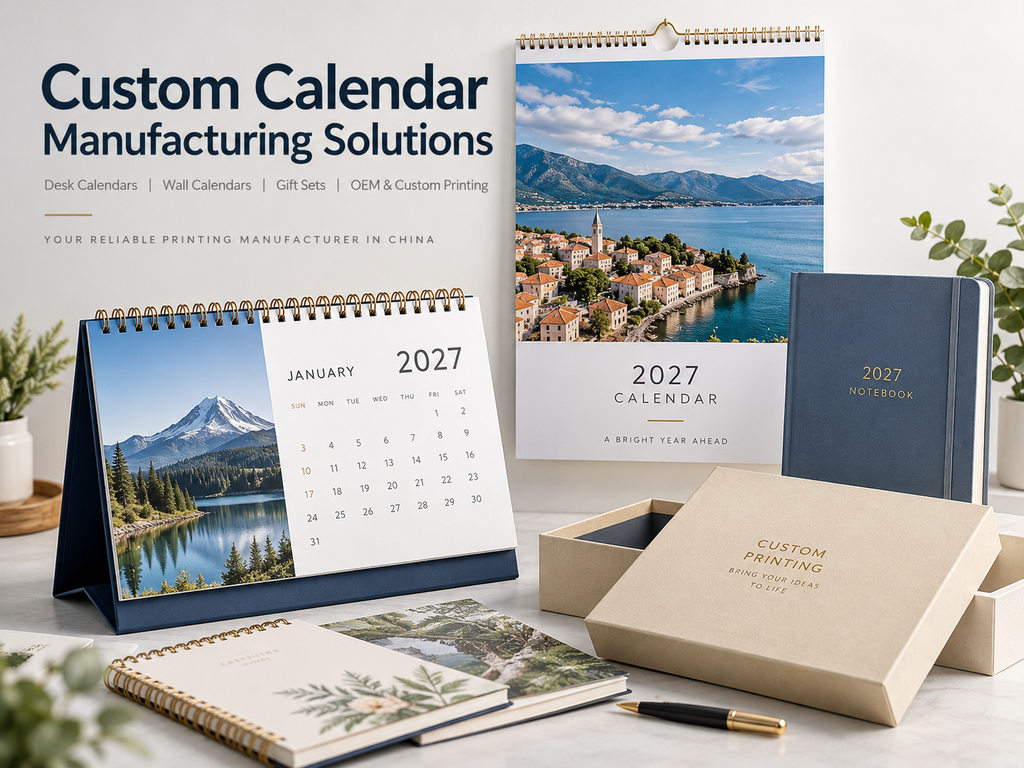
Desk calendars are commonly used for corporate gifts, office promotions, and branded merchandise. A typical design may include printed calendar sheets, Wire-O binding, and a folding paperboard easel stand. Buyers should confirm the finished size, number of sheets, base construction, and printing requirements.
Custom Wall Calendars
Wall calendars may feature large-format photography, illustrations, promotional messages, or branded artwork. Binding, hanging methods, paper selection, and packaging should be considered early in the project.
Calendar Gift Sets
Some projects combine a calendar with a notebook, stationery, or presentation box. These programs require coordination between individual products and their final packaging. Buyers exploring related items can also review custom notebook manufacturing and collapsible rigid box options.
2. Evaluate Manufacturing Capabilities, Not Just Printing Prices
A custom calendar is a finished paper product, not simply a set of printed pages. Depending on the design, production may involve prepress preparation, offset printing, surface finishing, trimming, binding, paperboard assembly, packing, and quality inspection.
When comparing manufacturers, ask which operations they perform directly and which require external suppliers. The objective is not necessarily to avoid subcontracting, but to understand how the project will be coordinated and how quality will be controlled.
Manufacturers should also be able to discuss practical design considerations, such as whether a selected paper stock is suitable for the intended binding or whether a proposed base structure can support the finished calendar.
For an overview of QYC Print’s production resources, visit our printing equipment page and manufacturing services.
3. Confirm Materials and Product Specifications
Clear specifications are essential for accurate quotations and consistent production. Before requesting a price, prepare as much of the following information as possible:
- Calendar format: desk calendar, wall calendar, or gift set.
- Finished dimensions: width, height, and orientation.
- Page count: number of sheets, printed sides, and cover requirements.
- Paper materials: preferred paper type and weight, if known.
- Printing: full-color or other printing requirements.
- Binding: Wire-O, spiral, stapled, or another suitable method.
- Finishing: lamination, special coatings, foil stamping, or other requested effects.
- Packaging: individual packing, cartons, or presentation boxes.
- Order quantity: total quantity and number of artwork versions.
- Delivery: destination, preferred shipping arrangement, and required delivery date.
If some details are undecided, share reference photographs, drawings, or a physical sample. A manufacturer can then assess suitable materials and construction options before finalizing the quotation.
4. Understand the Sampling and Approval Process
Sampling is an important step in OEM calendar production, particularly when the project includes custom paperboard structures, special finishes, or multiple products.
Depending on the project, buyers may review digital proofs, printed samples, material samples, or assembled prototypes. These serve different purposes. A digital proof can help confirm content and layout, while a physical sample is more useful for checking materials, binding, structure, and handling.
Before approving production, verify:
- Artwork, calendar dates, languages, and spelling.
- Finished dimensions and page sequence.
- Paper appearance and surface finish.
- Binding position and page-turning performance.
- Desk calendar base stability or wall calendar hanging method.
- Packaging fit and overall presentation.
Final production should follow an agreed specification and approved sample version. Any changes after approval should be documented because they may affect cost, production timing, or product performance.
5. Plan Production and Delivery Early
Calendar projects are often tied to seasonal sales, corporate events, or year-end gift campaigns. This makes production scheduling especially important.
Buyers should consider the full project timeline, including artwork preparation, technical review, sampling, approval, printing, finishing, assembly, packing, and transportation. The time required will vary according to product complexity, quantity, material availability, and delivery destination.
For projects with multiple calendar designs or coordinated gift items, clarify whether all versions need to ship together. This can affect production sequencing and packaging arrangements.
Rather than relying on a general lead-time estimate, request a schedule based on your confirmed specifications and intended delivery date.
6. Compare Quotations on the Same Basis
The lowest quoted unit price is not always the lowest total project cost. A useful supplier comparison should account for materials, construction, printing quality, sampling, packaging, and shipping arrangements.
When reviewing quotations, confirm whether the quoted price includes:
- The same dimensions, materials, page count, and finishing.
- All required binding and structural components.
- Sample charges, if applicable.
- Individual packaging and export cartons.
- Delivery terms and any separately charged services.
It is also worth asking how artwork revisions, additional product versions, or specification changes would affect the final price.
7. Consider a Manufacturing Partner for Related Paper Products
For businesses that regularly develop branded stationery or promotional products, calendars may be one part of a broader purchasing program.
Working with a manufacturer experienced in several paper-based product categories can make it easier to coordinate calendars with notebooks, packaging, and other printed components. The practical benefit is a clearer project structure and fewer disconnected specifications.
QYC Print is a Guangzhou-based printing and packaging manufacturer established in 1988. We support custom paper-based product manufacturing, including calendars and related printed products. Buyers can explore our custom desk and wall calendar manufacturing capabilities and related product categories on our website.
8. Prepare an Effective Calendar RFQ
To receive a more useful quotation, provide a short project brief with the product format, dimensions, quantity, artwork status, material preferences, packaging requirements, and target delivery date.
If you are developing a new calendar structure or a coordinated gift set, include photographs or sketches and identify which details are flexible. This allows the manufacturer to discuss feasible options rather than quote against incomplete assumptions.
Conclusion
Choosing a custom calendar manufacturer in China is ultimately about finding a partner who understands both printing and finished-product manufacturing. Clear specifications, appropriate sampling, transparent quotations, and realistic production planning can help reduce avoidable revisions and improve the purchasing process.
Planning an OEM calendar project? Explore QYC Print’s custom calendar solutions or contact our team with your specifications to discuss manufacturing options and request a quotation.