Board Game Rulebook Printing for Publishers and Game Creators
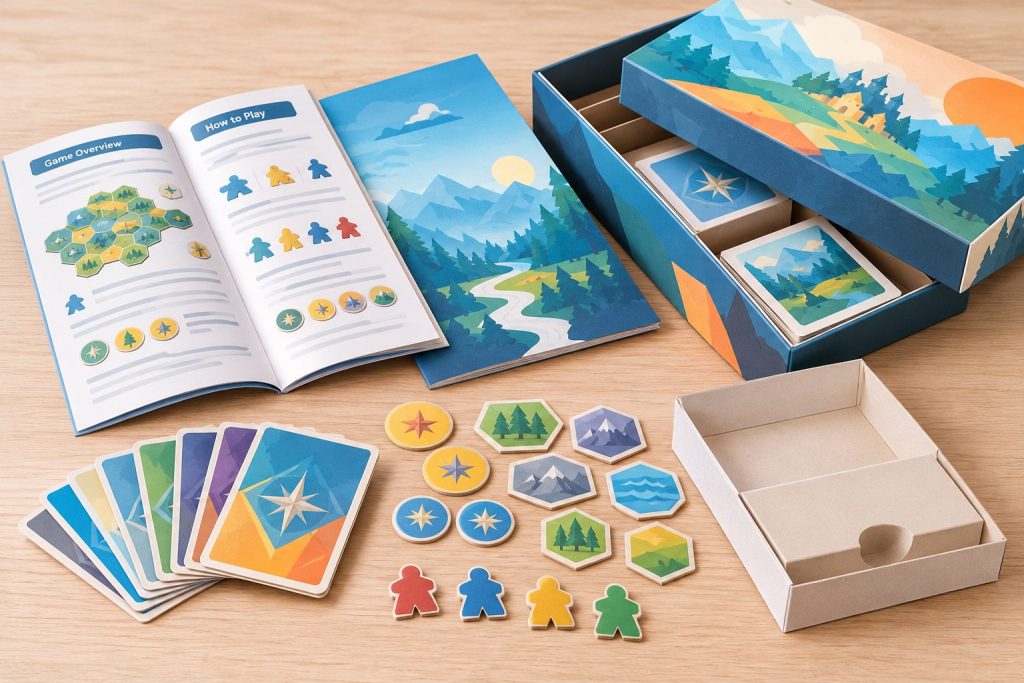
A board game rulebook does more than explain how to play. It is part of the overall product experience, alongside printed cards, punchboards, paper inserts and the game box.
For tabletop game publishers, independent creators and educational game developers, coordinating these printed components before production helps reduce avoidable changes during manufacturing and packing.
1. Choose the Right Rulebook Format
Different games need different instruction formats. A compact card game may use a folded instruction leaflet, while a strategy or story-driven game may require a multi-page rulebook or separate scenario booklets.
Key specifications to confirm
- Finished size and orientation
- Number of pages, including cover pages
- Paper type and grammage (gsm)
- Full-color or black-and-white printing
- Binding and folding method
- Quantity per game and total order quantity
The right format should support readability while remaining compatible with the packaging design.
2. Paper and Binding Options
Paper choice affects appearance, handling and thickness. Coated stocks may be suitable for illustrated instructions, while uncoated stocks offer a different tactile finish. The preferred grammage depends on page count, booklet dimensions and project requirements.
Common construction methods
- Folded instruction sheets: Suitable for short instructions and compact card games.
- Saddle-stitched booklets: Often considered for thinner multi-page rulebooks.
- Perfect-bound books: An option for sufficiently thick publications, subject to binding feasibility.
Binding suitability should be reviewed against the final page count, paper thickness and finished dimensions before quotation.
3. Coordinate Rulebooks with Other Printed Game Components
Rulebooks are frequently packed with cards, printed boards, cardboard tokens and paper-based inserts. Planning the full set together helps manufacturers evaluate production and packing requirements.
Example paper-based component BOM
| Component | Specifications to provide |
|---|---|
| Rulebook | Size, page count, paper, binding, quantity |
| Scenario booklet | Edition, page count, binding, quantity |
| Printed cards | Card size, stock, finish, number of designs |
| Cardboard tokens | Board thickness, die-cut layout, printing |
| Paper insert | Material, structural drawing, compartments |
| Printed game box | Internal dimensions, structure, finish |
Wooden, plastic or metal game accessories, when required, should be assessed separately through appropriate supply-chain partners rather than treated as in-house paper printing operations.
4. Check Booklet Thickness and Box Fit
A change in rulebook page count can affect the thickness of the finished booklet. This matters when the box also contains card decks, punchboards and inserts.
Before mass production, consider reviewing a physical packing sample containing the intended component set. Check whether the box closes correctly, whether the contents are secure and whether the printed materials can be removed without damage.
The final packaging assessment should use actual materials and production specifications rather than relying only on a digital layout.
5. Prepare Multilingual and Scenario Editions
Localized tabletop games may contain different language editions, scenario booklets or campaign guides. These versions should be identified clearly in the artwork files and component list.
- Assign an edition or language identifier to each file.
- Confirm the final page count for each language.
- Match the correct booklet to the corresponding card and box edition.
- Provide packing instructions when different editions share a production run.
- Approve final print-ready files before production.
Translation can change text length and pagination. Each localized version should therefore be checked independently.
6. What to Include in a Rulebook Printing RFQ
A clear request for quotation helps a manufacturer evaluate the project accurately.
- Game title and project type
- Rulebook and scenario booklet dimensions
- Page count and number of versions
- Preferred paper and binding specifications
- Artwork availability and file format
- Quantity per game and total manufacturing quantity
- Other printed components and packaging specifications
- Required delivery destination and schedule
- Sample, packing and quality-control requirements
If the paper grammage or binding method is not yet finalized, share the intended product use and available design information so suitable manufacturing options can be evaluated.
7. Frequently Asked Questions
What paper is suitable for a board game rulebook?
The choice depends on booklet size, page count, illustration requirements, handling and budget. Both coated and uncoated paper may be considered depending on the desired result.
Can a rulebook and scenario booklet be printed together?
Yes. Multiple printed components can be evaluated as part of the same tabletop game project, with separate specifications and quantities for each item.
Can different language editions be produced?
Different language editions can be reviewed for printing, provided each version has clearly identified and approved artwork, specifications and packing instructions.
Why should the rulebook be checked against the game box?
The booklet occupies space alongside other game components. Its finished thickness and dimensions can affect box fit and packing efficiency.
Can QYC Print help with paper-based board game components?
QYC Print supports custom printing and paper-based packaging projects, including rulebooks, printed cards, cardboard components and packaging boxes. Non-paper accessories can be assessed separately through supply-chain partners where appropriate.
8. Discuss Your Board Game Printing Project with QYC Print
QYC Print is a Guangzhou, China-based printing and packaging manufacturer established in 1988. We work with custom paper printing and packaging requirements for publishers, brands and product developers.
If you are preparing a tabletop game, educational card game or story-based board game, share your rulebook specifications, component list and packaging requirements for a manufacturing feasibility review.
Explore QYC Print: QYC Print – Custom Printing and Packaging Manufacturer.