Commercial Printing Projects: How to Choose the Right Printing Manufacturer
Commercial printing projects often involve more than ordering a single brochure or catalog. For brands, marketing teams, publishers and corporate buyers, a printing project may include several products with different sizes, paper stocks, finishing requirements and delivery schedules.
Choosing the right manufacturing partner is therefore not simply about comparing printing prices. It is also about coordinating product specifications, print quality, finishing and production planning.
This guide explains the main components of commercial printing projects, the questions buyers should ask and how to prepare a clear manufacturing inquiry.
What Are Commercial Printing Projects?
Commercial printing projects are business-oriented printing programs designed to support marketing, communication, product presentation, corporate identity or distribution.
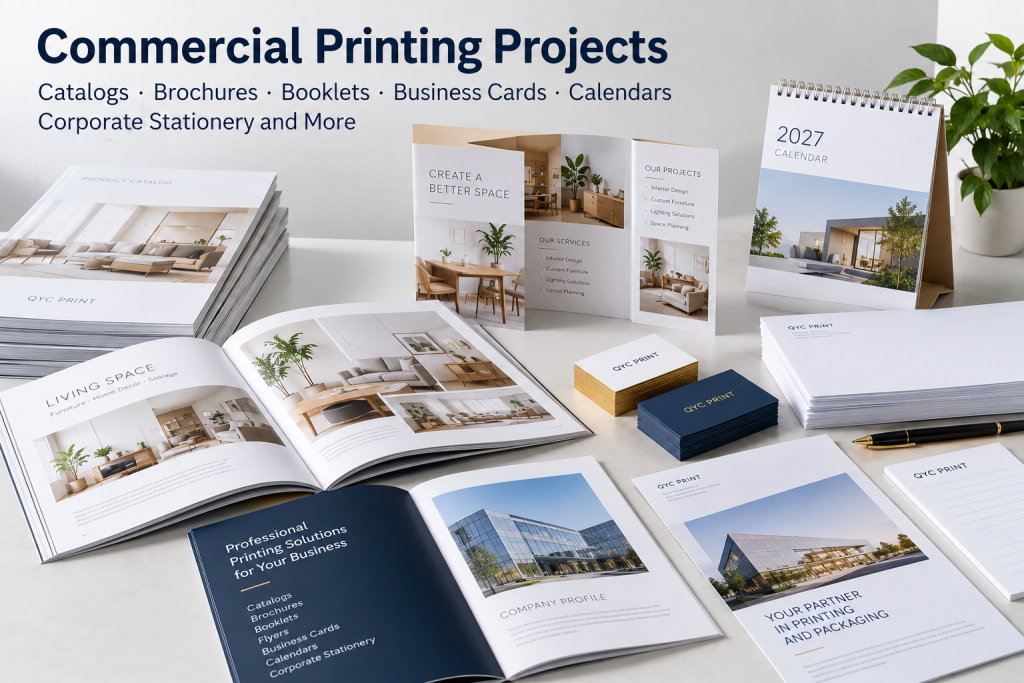
A single project may involve several related printed products, such as catalogs, brochures, booklets, business cards and promotional materials. Each item may require a different paper weight, binding method, surface finish or packaging arrangement.
At QYC Print, we approach these requirements as part of broader
paper product manufacturing projects,
connecting finished products with their printed components and manufacturing processes.
Common Products in Commercial Printing Projects
1. Product Catalogs
Printed catalogs help companies present product ranges, specifications, photographs and brand information. Manufacturing considerations include page count, paper selection, binding, color consistency and cover finishing.
2. Brochures and Marketing Booklets
Brochures and booklets are frequently used for exhibitions, product launches, corporate presentations and sales activities. Depending on the project, they may use folded sheets, saddle stitching or other suitable binding methods.
3. Flyers and Promotional Inserts
Flyers, leaflets and inserts communicate focused information in a compact format. Buyers should consider finished size, folding requirements, paper weight and the quantity needed for each campaign.
4. Business Cards and Corporate Stationery
Business cards, letterheads, envelopes and note cards contribute to a consistent brand identity. Paper texture, printing method, color and optional finishes can influence their appearance and handling.
5. Custom Calendars
Corporate calendars are often used as promotional or relationship-building products. Wall calendars, desk calendars and other formats may involve additional components, binding and packaging.
Why Coordinating Multiple Printed Products Matters
Consider a company preparing for an international trade exhibition. Its printed materials might include a product catalog, company brochure, business cards, promotional flyers and branded presentation folders.
Although these are separate products, they share common requirements:
- Consistent brand colors and visual presentation
- Compatible paper stocks and surface finishes
- Clear artwork specifications and approval procedures
- Coordinated production schedules
- Suitable packing and shipment preparation
A manufacturer familiar with multi-product paper manufacturing can help buyers review these requirements together instead of treating every printed item as an unrelated order.
How to Choose a Commercial Printing Manufacturer
Evaluate Printing and Finishing Capabilities
Ask whether the manufacturer can support your required printing methods, materials, binding and finishing processes. Some projects need more than printing alone, especially when they include folded materials, specialty covers, inserts or assembled sets.
Check Material and Specification Compatibility
Paper selection affects thickness, appearance, handling and cost. Uncoated, coated and specialty stocks serve different purposes. Buyers should review material samples and confirm the specifications before production.
Discuss Sampling and Artwork Approval
Sampling helps identify potential issues with size, color, folding, binding and finishing. Ask how the manufacturer handles artwork checks, proofs and sample approvals before mass production.
Review Production Coordination
For projects involving several printed products, clarify whether the supplier can coordinate specifications, production stages, packing requirements and delivery planning across the complete order.
Consider Communication and Export Requirements
International buyers should discuss shipment destination, packing specifications, labeling and any documentation requirements early in the project. Requirements vary by product and destination, so they should be confirmed individually.
Commercial Printing Methods and Finishing Options
Offset printing is commonly considered for suitable commercial print runs, particularly when consistent reproduction across multiple sheets is important.
Depending on the product design, finishing options may include:
- Matte or gloss lamination
- Foil stamping
- Embossing or debossing
- Die-cutting
- Folding and creasing
- Saddle stitching or other binding methods
Not every process is appropriate for every product. The best choice depends on the intended use, material, quantity, artwork and budget.
How to Prepare a Commercial Printing Inquiry
A detailed inquiry helps the manufacturer evaluate feasibility and prepare a more accurate quotation.
Before requesting pricing, prepare the following information:
- Product types: Catalogs, brochures, booklets, cards or other printed items.
- Finished dimensions: Width, height and orientation.
- Quantity: Required units for each product.
- Paper specifications: Preferred paper type and weight, if known.
- Printing details: Color requirements and printed sides.
- Finishing: Lamination, folding, binding, foil stamping or other processes.
- Artwork: Available design files and approval requirements.
- Packaging and delivery: Packing preferences, destination and target schedule.
If some specifications are not yet finalized, explain the product’s intended use and ask the manufacturer to evaluate suitable options.
Why Work With QYC Print?
Established in 1988, QYC Print is a Guangzhou-based printing and packaging manufacturer supporting custom paper-based products for business customers.
Our manufacturing scope includes commercial printing, books, cards, packaging and related paper components. Heidelberg offset printing equipment and in-house finishing capabilities support projects that require coordinated production.
Learn more about our
product manufacturing solutions
and
printing and finishing capabilities.
Frequently Asked Questions
Can different printed products be manufactured within one project?
Yes. A commercial printing project may include multiple related products. Feasibility depends on each item’s specifications, quantities, materials and finishing requirements.
What information is needed for a printing quotation?
Product type, size, quantity, paper, printing colors, finishing, artwork and delivery requirements are the main starting points.
Is offset printing suitable for every order?
Not necessarily. The appropriate production method depends on quantity, design, materials, quality requirements and overall project specifications.
Can a manufacturer help review paper and finishing options?
Yes. Buyers can discuss the intended product use and request recommendations based on available materials and manufacturing processes.
Start Your Commercial Printing Project
Whether you need a product catalog, a coordinated corporate stationery set or several printed materials for a product launch, clear specifications and manufacturing planning are essential.
Explore QYC Print’s
manufacturing projects
or contact our team to discuss your requirements.