1. Identify Every Component in Your Board Game
Start with a complete component list rather than requesting a price for cards or a game box alone. The final product may contain several printed and converted paper parts, each with its own dimensions, material, finishing, and packing requirements.
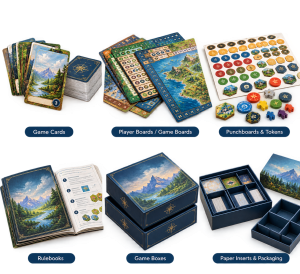
- Playing cards: question cards, action cards, character cards, learning cards, or standard game cards.
- Game boards: folding boards, multi-panel boards, or other board formats based on the game design.
- Punch-out components: tokens, counters, tiles, markers, and cardboard standees.
- Printed materials: rulebooks, quick-start guides, player aids, score sheets, and reference cards.
- Supporting paper parts: paper inserts, labels, sticker sheets, and printed information sheets.
- Packaging: game boxes, internal paperboard supports, and other printed packaging components.
The exact component range depends on the game. A compact card game may need only cards, instructions, and a box, while an educational activity kit may combine a booklet, flash cards, stickers, and multiple paper pieces.
2. Choose Materials for the Way Players Will Use the Game
Material selection should reflect how often each component will be handled, how it will be stored, and how it must perform during play. The most expensive material is not automatically the best choice; the goal is to match the material to the intended use and target price.
Card stock and printed cards
When specifying cards, discuss the stock, thickness, surface, opacity, flexibility, and intended handling experience. If cards will be shuffled frequently, the feel and durability of the finished card matter alongside print appearance. Confirm whether a protective coating or laminate is required and test the finished sample before approving mass production.
Game boards and punch-out sheets
Game boards and punch-out components require attention to board thickness, printed surface quality, folding or creasing structure, cutting accuracy, and edge finish. For punch-out pieces, the artwork and die-cut layout should be reviewed together so important graphics are not placed too close to cut lines.
Rulebooks and other printed paper parts
Rulebooks, player aids, and reference sheets should be easy to read and appropriately sized for the box. Confirm page count, finished dimensions, binding or folding method, and whether diagrams or color-coded instructions need special treatment.
3. Prepare Artwork and Technical Specifications Before Quotation
A board game components manufacturer can assess a project more accurately when the specifications are complete. Early clarification also helps reduce avoidable changes during sampling and production.
Prepare the following information where available:
- Component list and quantity of each component per game set.
- Finished dimensions, thickness, and material requirements.
- Artwork files, color requirements, bleed, and safe areas.
- Card count, board structure, punch-out layout, and rulebook page count.
- Surface finishing, lamination, coating, or other required treatments.
- Box dimensions, closure style, internal arrangement, and packing method.
- Target order quantity, delivery destination, required delivery date, and packaging requirements.
If some specifications are not finalized, identify them as open decisions instead of assuming they are confirmed. A manufacturer can then help review feasible options before the design is locked.
4. Coordinate Printing, Die-Cutting, Folding, and Assembly
Board game production involves several connected processes. Printed sheets may need to be laminated or coated, die-cut into individual parts, creased for folding, collated into sets, and packed into the final box. A problem in one stage can affect the fit or appearance of the complete product.
For example, a punch-out sheet should be evaluated for both graphic placement and cutting layout. A folding board needs the panel dimensions and fold positions to match the approved structure. Cards and instruction booklets must also fit the intended box without being excessively loose or difficult to remove.
When evaluating a supplier, ask which processes are handled in-house and which are subcontracted. Coordinating related paper components through one manufacturing partner may reduce handoffs, but the actual process arrangement should be confirmed for each project.
5. Design the Game Box Around the Complete Set
The box should protect the components, present the game clearly, and support efficient packing and storage. Its internal dimensions should be based on the complete component set, including any inserts, instruction materials, and protective packaging.
Before approving the box, confirm:
- The finished dimensions and required clearance for all components.
- Whether internal dividers, paperboard supports, or other inserts are needed.
- How the components will be arranged and removed by the player.
- The box material, printed wrap, surface finish, and closure method.
- How the packed game will be protected during storage and transportation.
Premium projects may require a more rigid presentation box, while other games may use a simpler structure to meet a target cost. For suitable projects, explore QYC Print’s collapsible rigid box packaging as one possible packaging direction. The appropriate construction depends on the game dimensions, protection requirements, and budget.
6. Build the Quotation Around the Complete Game Set
Comparing unit prices is useful only when suppliers are quoting the same specification. One quotation may include cards and a box, while another includes the game board, rulebook, punch-out pieces, collation, and export packaging.
Ask for the quotation to identify the included components and relevant production assumptions. Review these cost factors:
- Paper and board grades, thicknesses, and material consumption.
- Printing coverage, number of designs, and color requirements.
- Die-cutting tools, special structures, finishing, and binding.
- Assembly, collation, and packing labor.
- Sampling, proofing, and any required testing or documentation.
- Outer cartons, packing configuration, freight, and delivery terms.
If you are comparing multiple suppliers, use the same component list, quantities, material assumptions, and delivery terms. This makes it easier to understand whether a price difference comes from manufacturing efficiency or from a difference in scope.
7. Approve Samples Before Starting Mass Production
Samples are especially important when a game contains several interacting paper components. A printed card may look correct on screen but feel different in hand. A board may fold differently than expected, and punch-out pieces may need adjustments to the cutting layout.
Review the sample against a written checklist:
- Artwork, text, color appearance, and print registration.
- Card thickness, surface, flexibility, and handling feel.
- Board dimensions, folds, creases, and edge quality.
- Punch-out accuracy and the position of critical graphics.
- Rulebook readability and completeness.
- Component count, fit inside the box, and ease of packing.
Record any approved changes before production. The final sampling method, timing, and acceptance criteria should be agreed for the specific project.
8. Consider Educational Games and Learning Kits
Not every tabletop product is a conventional board game. Educational publishers and learning brands may need activity cards, picture books, stickers, game boards, and instructions packaged as one coordinated kit. These products require careful component counting, clear organization, and a consistent visual identity across different formats.
For projects that combine books and learning materials, explore QYC Print’s educational products manufacturing capabilities. You can also review the children’s books product area when the game or activity set includes a printed book component.
Discuss the complete kit rather than treating each printed item as an unrelated order. This gives the manufacturing team a clearer view of component relationships, packing sequence, and the finished product requirements.
9. How to Choose a Board Game Components Manufacturer
A suitable manufacturing partner should understand the relationship between artwork, paper materials, converting processes, component fit, and final packaging. A low initial price is not enough if important components are excluded or production assumptions are unclear.
Use these questions when evaluating a potential supplier:
- Can the supplier quote the complete component set against a clear specification?
- Can it explain the relevant printing, finishing, die-cutting, and assembly processes?
- Will it identify technical questions before sampling or mass production?
- Can it coordinate the required paper components and packaging?
- Are material choices, tolerances, sampling, and acceptance criteria documented?
- Can the supplier confirm the requested order quantity, schedule, packing method, and shipping scope?
QYC Print is a Guangzhou printing and packaging manufacturer established in 1988, serving projects involving printed paper products and packaging. Depending on the project specification, a coordinated scope may include cards, printed booklets, paper components, and packaging. Review the QYC Print project portfolio and discuss your component list to determine whether the requirements fit the available manufacturing processes.
10. Board Game Components Manufacturing Checklist
Before requesting a quotation, make sure you can answer the following questions:
- What components are included in one finished game set?
- What are the dimensions, materials, thicknesses, and quantities of each component?
- Are the artwork and die-cut layouts ready for technical review?
- What finishing, folding, binding, or assembly processes are required?
- How should the components fit inside the final box?
- What sample approvals or tests are required before production?
- What order quantity, delivery location, and target schedule should be quoted?
- Does the quotation clearly state what is included and excluded?
Frequently Asked Questions
What does a board game components manufacturer produce?
Depending on its equipment and production scope, a manufacturer may produce printed cards, game boards, punch-out tokens, rulebooks, player aids, paper inserts, labels, and game packaging. Confirm the available processes and product specifications with each supplier.
Can different paper components be quoted together?
Yes, if the supplier can manufacture or coordinate the required components. Provide a complete bill of materials, component quantities, artwork status, packaging requirements, and delivery details so the quotation can reflect the intended finished set.
What information is needed for a board game manufacturing quote?
At minimum, prepare the component list, dimensions, material requirements, artwork or design status, order quantity, packaging concept, delivery destination, and target schedule. Unconfirmed specifications should be marked clearly for review.
Why is a physical sample important?
A physical sample helps verify print appearance, material feel, cutting accuracy, folding, component fit, and packing arrangement before mass production. It also provides a reference for recording approved changes and acceptance requirements.
Plan Your Board Game Production Project
A well-planned board game starts with a clear component list and a coordinated production specification. By reviewing materials, artwork, die-cutting, finishing, box structure, sampling, and packing together, publishers and product developers can make more informed manufacturing decisions.
Prepare your component list and project requirements before requesting a quotation from QYC Print. The manufacturing scope, materials, sample process, lead time, and final price can then be reviewed against the details of your specific project.